

Key Takeaways
- An apostille stamp (or apostille certificate) is an official international certificate that confirms the authenticity of a public document for use in another country.
- Apostilles only apply between countries that are members of the 1961 Hague Apostille Convention—over 120 countries as of 2026.
- The apostille verifies the signature, seal, or stamp on a document, not the actual content of the document itself.
- Without an apostille, many foreign authorities (courts, universities, registries) will not accept documents such as birth certificates, diplomas, or powers of attorney from abroad.
- You must obtain an apostille from the country where the document was issued, not from the country where you plan to use it.
Introduction: Understanding the Apostille Stamp
An apostille stamp is a standardized international certificate attached to a document to make it legally valid in another country. Think of it as a universal seal of approval that tells foreign authorities, “Yes, this document is genuine and was properly issued.”
The Hague Apostille Convention of 5 October 1961 created this simplified method of document authentication. Before this treaty existed, getting a document recognized abroad meant navigating a frustrating chain of offices: the issuing authority, then the foreign ministry, then the embassy or consulate of the destination country. The process could take weeks or months and cost hundreds of dollars.
Here are a few concrete examples of when you might need an apostille:
- Using a U.S. diploma to enroll in a master’s program in Spain
- Registering a marriage certificate from Canada with authorities in Italy
- Presenting a power of attorney from the UK to complete a property transaction in Mexico
- Submitting an FBI background check to work as an English teacher in South Korea
For assistance with international document authentication, including apostille translation services, compare top providers to ensure your paperwork is accepted abroad.
The apostille replaces all those bureaucratic steps with a single certificate, making international document recognition faster, cheaper, and far less stressful.
What Is an Apostille Stamp? (Definition and Purpose)
An apostille is a standardized certificate, usually a stamp or attached sheet, issued by a designated authority that confirms the authenticity of the signature, seal, or stamp on a public document.
In practice, an apostille certificate often appears as a separate page stapled or glued to the original document. It contains exactly ten standard data fields mandated by international agreement:
- The title “Apostille (Convention de La Haye du 5 octobre 1961)”
- Country of issuance
- Name of the person who signed the document
- Capacity in which that person acted (notary, registrar, judge)
- Details of any seal or stamp on the document
- Date and place of the apostille issuance
- The issuing authority’s name
- A unique certificate number
- The issuing authority’s signature
- The issuing authority’s official seal
Although commonly called an “apostille stamp,” in many countries it’s actually a printed certificate with a seal, barcode, or QR code—not just a simple rubber stamp.
The apostille does not validate or approve the content of the document. It only confirms that the document was properly issued or signed by an authorized person.
For example, an apostille on a university diploma confirms that the registrar’s signature is genuine. It does not certify that you actually earned good grades or that the university meets certain academic standards.
Typical public documents that can receive an apostille include:
- Civil status records (birth certificates, marriage certificates, death certificates)
- Educational documents (degrees, transcripts, diplomas)
- Court documents and notarial acts (affidavits, powers of attorney, sworn statements)
- Company registry extracts and official certificates

The Hague Apostille Convention: Legal Basis
The full name of the treaty is the Hague Convention of 5 October 1961 Abolishing the Requirement of Legalisation for Foreign Public Documents. It was created by the Hague Conference on Private International Law to solve a very practical problem: documents were getting stuck in bureaucratic limbo between countries.
Key points about the Convention:
- It removes the need for consular legalisation between its member (“contracting”) states
- It replaces multiple authentication steps with a single apostille issued in the country where the document originates
- Member countries must accept an apostille from another member country without further verification
As of 2026, around 129 states are parties to the Convention. Some notable members include:
Region | Member Countries (Examples) |
|---|---|
North America | United States, Canada, Mexico |
Europe | United Kingdom, France, Germany, Spain, Italy |
South America | Brazil, Argentina, Chile, Colombia |
Asia-Pacific | India, Japan, South Korea, Australia, New Zealand |
The United States joined the Convention on October 15, 1981, and individual states like Georgia designated offices such as the Georgia Superior Court Clerks’ Cooperative Authority (GSCCCA) to handle apostille requests.
Some countries—including Iran, Lebanon, and certain Southeast Asian nations—have discussed accession but may not yet be full members. Always check the current status on the official Hague Conference (HCCH) website before assuming a country accepts apostilles.
If either the issuing state or the destination state is not a party to the Apostille Convention, you’ll need a different process called “authentication” or “legalisation” instead.
When Do You Need an Apostille Stamp?
You typically need an apostille whenever an official document issued in one country must be legally recognized in another Apostille Convention country. The requirement comes from the receiving country’s authorities—not from the notary or the person issuing the original document.
Here are common scenarios where you’ll need an apostille:
- Dual citizenship applications: Using a U.S. birth certificate to obtain citizenship or register a child’s birth in Italy, Spain, or Portugal
- Studying abroad: Presenting a UK university diploma to enroll in a graduate program in France, Germany, or the Netherlands
- International employment: Submitting an American FBI background check to work or teach English in South Korea, Chile, or Japan
- Property transactions: Using a power of attorney issued in Canada to buy or sell real estate in Mexico
- Marriage abroad: Registering a foreign marriage certificate from Mexico with local authorities in California or New York
- Inheritance claims: Presenting vital records like death certificates to claim assets in another country
The receiving country dictates the rules. Universities, courts, civil registries, and immigration offices each have their own requirements about which documents need apostilles and in what format (original vs. certified copy).
Before spending money on apostilles, contact the foreign authority directly. Ask:
- Which specific documents do you require?
- Do you need an original or a certified copy?
- Are there translation requirements?
- How recent must the document be?
What Types of Documents Can Receive an Apostille?
The Apostille Convention applies to “public documents,” a term defined broadly in the treaty. This includes documents issued by government officials, court documents, notarial acts, and administrative documents.
Here are the main categories:
Civil status documents
- Birth certificates issued by a vital records office
- Marriage certificates from a county clerk or civil registry
- Death certificates from state or local authorities
Court and administrative documents
- Court judgments and divorce decrees
- Adoption orders
- Criminal record checks from police or justice ministries
Notarial acts
- Affidavits and sworn statements
- Powers of attorney executed before a notary public
- Declarations and acknowledgments
Educational records
- High school diplomas and transcripts
- University degrees and academic certificates
- Professional certifications from recognized institutions
Commercial documents and company records
- Certificates of incorporation
- Good-standing certificates
- Registry extracts for corporations and limited liability companies
Certain documents are excluded under the Convention:
- Diplomatic and consular documents
- Some documents related directly to customs operations
- Documents that already fall under different international agreements
Private documents like personal letters or private contracts cannot receive an apostille unless they are first notarized. Once a notary public certifies the document, the notary’s signature can then be apostilled.
How an Apostille Stamp Works in Practice
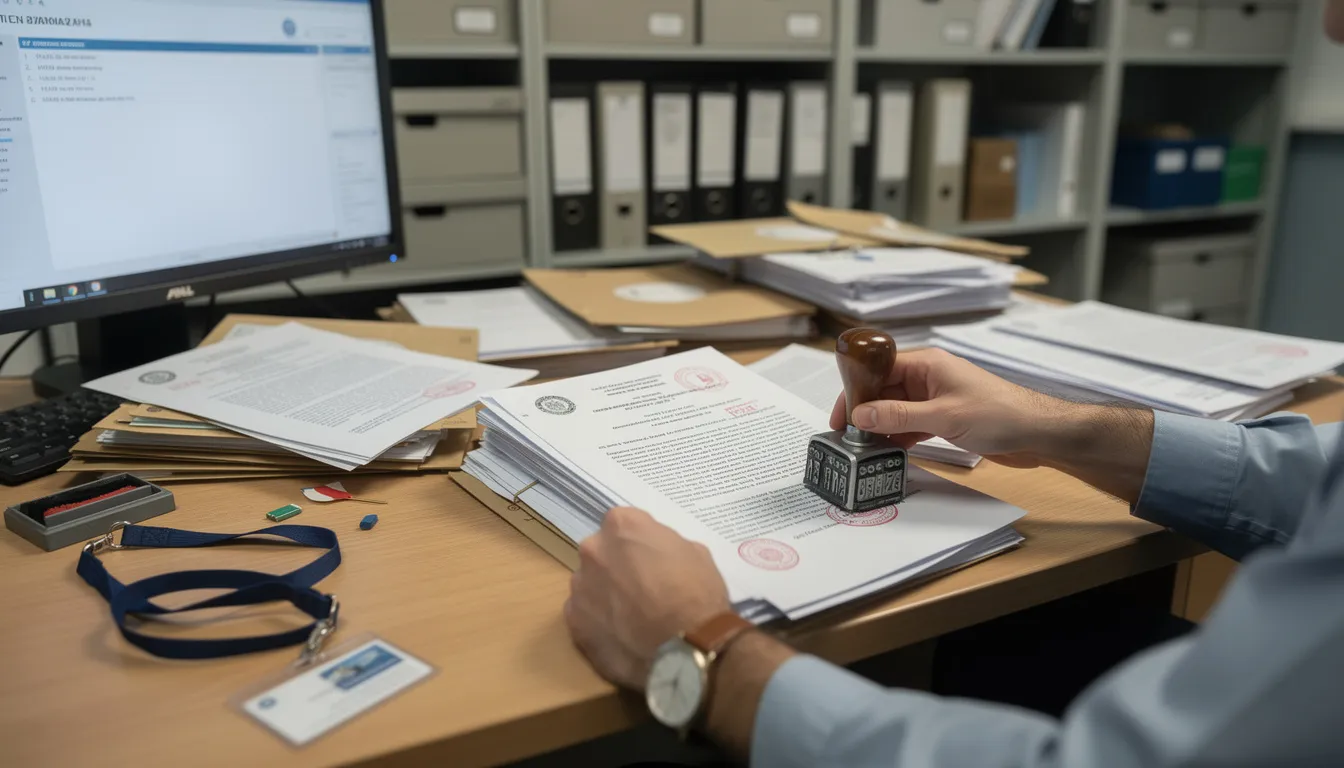
The apostille is attached in the country where the document was issued. When you present the completed document abroad, the foreign authority checks the apostille—not every prior signature in the authentication chain.
A standard apostille certificate contains:
- Reference to the Hague Convention of 5 October 1961 and the issuing country
- The name of the person whose signature is being certified and their capacity (notary, registrar, judge, government official)
- Details of any seal or stamp on the original documents
- Date and place of apostille issuance
- The issuing authority’s name, title, and official seal
- A unique number, register entry, or security feature (barcode/QR code) for verification
Foreign authorities in another Convention state must accept the apostille as sufficient evidence of the document’s origin. They cannot send it back through embassies or consulates for further legalisation.
Many countries now operate e-Apostille systems. These electronic apostilles include a verification code that allows authorities to confirm authenticity online, reducing the risk of forgery. The Hague Conference has been piloting digital signatures since 2019, allowing PDF-based processing while maintaining paper standards.
Regarding validity: the apostille remains valid as long as the underlying document is valid. There’s usually no separate expiry date for the apostille itself. However, some destination authorities impose time limits on how recent the document must be. Background checks, for example, often must be issued within the last 3 or 6 months.
Who Issues Apostille Stamps? (Competent Authorities)
Each Apostille Convention country designates its own “competent authorities” to issue apostilles. These authorities differ from state to state and from country to country.
Here are examples of issuing authorities in specific locations:
Country | Issuing Authority | Document Types |
|---|---|---|
United States | Secretary of State’s office (state-level) | State and federal documents notarized in that state |
United States | U.S. Department of State (Washington, D.C.) | Federal documents like FBI checks, patents |
United Kingdom | FCDO Legalisation Office | Documents issued in England, Wales, Scotland |
France | Public prosecutor’s office at Courts of Appeal | Documents issued in that jurisdiction |
Brazil | Designated notarial and registry offices | Various documents since Brazil’s 2016 accession |
Spain | Courts, notarial colleges, government delegations | Varies by document type |
In the United States, the process works like this:
- For state-issued documents (birth certificates, marriage licenses, school transcripts), contact the secretary of state in the state where the document was issued or notarized
- For federal documents (FBI background checks, patents, federal court documents), submit to the U.S. Department of State’s Authentications Office
- Some states have a commonwealth office or lieutenant governor that handles apostilles
Apostille fees and processing time can vary widely even within a single country. Some state’s office locations offer same-day service for walk-in requests, while mail-in applications may take weeks.
Notaries cannot issue apostilles themselves. Some notary public offices offer facilitation services, but only the designated state authority can officially issue the apostille.
Always check the official website of your country’s competent authority for current rules, mailing address details, and fee schedules.
Apostille vs. Authentication Certificate (Non-Hague Countries)
The apostille is only used when both the issuing and receiving country are members of the Hague Apostille Convention. Otherwise, you’ll need an authentication certificate through a process called “chain legalisation.”
Here’s how they compare:
Feature | Apostille | Authentication Certificate |
|---|---|---|
When used | Both countries are Hague members | One or both countries are not members |
Process | Single certificate from origin country | Multiple steps through various offices |
Consular involvement | None required | Embassy/consulate legalisation required |
Speed | Faster (days to weeks) | Slower (weeks to months) |
Cost | Lower (single fee) | Higher (multiple fees) |
For non-Hague countries, the authentication process typically requires:
- Notarization of the document
- Authentication by a county clerk or state authority
- Certification by the U.S. Department of State
- Legalisation by the destination country’s embassy or consulate
Example scenario: A U.S. notarized power of attorney for use in the United Arab Emirates or Vietnam needs authentication by the state authority, then the U.S. Department of State, and finally the UAE or Vietnamese embassy or consulate. This chain is called “full legalisation.”
The word “legalisation” is sometimes used broadly to mean both apostille and traditional authentication. When dealing with foreign authorities, always ask specifically whether they want an “apostille” or an “embassy legalisation” to avoid confusion.
Step-by-Step: How to Get an Apostille Stamp
The exact procedure varies by country, but the general steps are similar. Here’s a practical checklist:
1. Confirm destination country requirements Contact the foreign authority (university, court, registry) and ask:
- Is an apostille required?
- Do they accept an original or a certified copy?
- What are the translation or language rules?
2. Obtain the correct document Request a recent certified copy from the issuing office. For example:
- A new birth certificate from vital records
- An official transcript from a university registrar
- A notarized copy if it’s a private document
3. Check formatting rules Ensure the document bears necessary signatures and seals. Some authorities will only apostille documents that:
- Follow specific layouts
- Have been pre-certified by local courts or ministries (for obtaining an apostille)
- Contain an original signature (no photocopies)
4. Identify the competent authority Find the correct apostille office for your document type:
- State secretary of state for state-issued items
- Department of State for federal documents
- Notary division or court for certain documents in some countries
5. Submit your request File the application in person, by first class mail, or through courier service. Include:
- The original document or certified copy
- Completed request form
- Payment of fees
- A prepaid return envelope if required
6. Pay the fee Fees range from free in some jurisdictions to over $150 per document. Check current rates before submitting.
7. Track processing Check estimated processing times and use tracking tools if the authority provides an online status system. Class mail requests may take longer than in-person submissions.
8. Receive and verify Once you receive the apostilled document, verify that:
- The apostille is attached correctly
- Your personal data and document references are accurate
- All seals and signatures are present
While some notaries and private agencies offer apostille services, they act as couriers or facilitators only. Only the designated state authority can officially issue apostilles.

Typical Processing Times and Costs
Timeframes and costs vary substantially by country, type of document, and method of submission. Here are realistic ranges:
United States
- Walk-in apostille from the secretary of state’s office: same day to 3 business days
- Mail-in requests: 1-3 weeks depending on workload
- Fees: typically $10-20 per document plus notary costs
United Kingdom
- FCDO Legalisation Office standard service: 1-2 weeks plus postage
- Priority or business services: shorter but more expensive
- Fees: varies by service level
Continental Europe (France, Spain, Germany)
- Processing can range from same-day issuance at a court or notarial authority to several days if preliminary certification needed
- Fees: €20-€30 per document in many EU states
Additional costs to consider
- Urgent processing or expedited handling fees
- Courier or registered mail charges
- International shipping time if documents are sent abroad
- Certified copy fees from the issuing office
Over 55 million apostilles are issued globally each year, reflecting steady demand driven by migration, international education, and global business activity.
Verify exact fees and timelines directly with the issuing authority when you apply. Processing times can change based on seasonal demand and staffing levels.
Limitations and Common Misunderstandings
Apostilles are powerful tools for document recognition, but they’re often misunderstood.
Misconception: The apostille certifies that all information in the document is true. Reality: It only certifies the authenticity of the signature, seal, or stamp—not factual accuracy.
Misconception: Any document can get an apostille. Reality: Only public documents or documents linked to public officials (such as notarized documents) qualify.
Misconception: An apostilled document will automatically be accepted everywhere. Reality: Acceptance is only guaranteed among Hague Convention states. Even then, additional requirements like translation or certified copies may apply.
Misconception: Apostilles never expire. Reality: While the apostille itself has no formal expiry date, many foreign authorities require that the underlying document be recent (often issued within the last 3-6 months).
Misconception: The embassy or consulate of the destination country issues the apostille. Reality: Apostilles are issued by the home country’s designated authority, not by foreign consular missions.
Misconception: The apostille guarantees the document isn’t forged. Reality: The apostille only confirms that the signature is genuine—it doesn’t verify the document’s content or detect fraud that occurred before the apostille was issued.
Some countries add disclaimers to their apostilles stating explicitly that the certification needed covers only the originator’s authority, not content validity.
Practical Tips Before You Apply for an Apostille
Careful preparation saves time, money, and the frustration of repeated applications.
Confirm exact requirements first Always verify with the receiving foreign authority which document they need (original, certified copy, or notarized copy) before ordering multiple versions. For Oklahoma apostille services, ensure you are meeting the destination country’s requirements.
Understand translation order Check whether the document must be translated before or after the apostille. Some countries want the apostille first, then a sworn translation. Others require translation before apostillation.
Verify personal information Double-check spelling of names, dates of birth, and other details on your document before submitting. Any error may require reissuing the document and paying fees again.
Keep copies of everything Maintain copies and digital scans of both the original documents and the apostille for your records. You may need to show proof to another institution later.
Plan for deadlines Account for processing time plus international shipping when you have visa applications, university enrollments, or court hearings approaching. The apostille process combined with delivery can take several weeks.
Use official channels Submit directly to the competent authority rather than through third parties when possible. If you use a courier service, ensure they’re reputable and understand the specific requirements.

FAQ
Is an apostille the same as a notarization?
No, they serve different purposes. Notarization is a national process where a notary public verifies a signer’s identity and witnesses their signature within one country. An apostille is an international certificate issued by a designated government authority to confirm the authenticity of a public document for use abroad.
Many documents destined for foreign use must first be notarized and then receive an apostille on the notary’s signature. The two steps involve different officials and have different legal effects—notarization happens first, and the apostille authenticates the notary’s signature for international recognition.
Do I need a new apostille every time I use the same document abroad?
Usually not. As long as the underlying document remains valid and the foreign authority accepts it, you can reuse the same apostilled document.
However, some institutions—especially immigration offices and agencies requesting criminal record checks—insist on very recent documents (issued within the last 90 days, for example). In these cases, you’ll need to obtain both a new document from vital records or the relevant office and a new apostille.
Can I get an apostille in the country where I am currently living, or only in the country that issued the document?
An apostille must always be issued by the country where the document originated. A French court judgment can only be apostilled in France. A U.S. birth certificate can only be apostilled in the United States.
If you live abroad, you have several options:
- Mail the document back to your home country
- Use a trusted contact or family member to submit on your behalf
- Hire a professional courier service to handle the process
Do I need to legalize an apostille at an embassy or consulate?
When both the issuing and receiving countries are members of the Hague Apostille Convention, no further consular legalisation is required. The apostille replaces that entire process—that’s the whole point of the Convention.
Embassy or consulate legalization is only relevant when the destination country is not a party to the Convention and therefore does not accept apostilles. In those cases, you’ll need the traditional chain legalisation process.
Does the apostille have to be translated for use abroad?
The Apostille Convention allows the apostille certificate itself to be issued in French plus one or more additional languages. Destination countries should not require a translation of the apostille’s standard wording, since the format is internationally recognized.
In practice, some authorities may still ask for a translation of the underlying document (and occasionally the apostille text). Always confirm local requirements with the institution that will receive the document before assuming translations aren’t needed.
