

Key Takeaways
- “Legalizing” a marriage certificate means obtaining an apostille or authentication so that foreign governments will accept it as valid. This process confirms the document’s authenticity without changing anything about the marriage itself.
- Hague Convention countries (such as Spain, Italy, and the Netherlands) require only an apostille, while non-Hague countries (such as the UAE, China, and Vietnam) require multi-step consular legalization involving the U.S. Department of State and the destination country’s embassy.
- The process typically begins with obtaining a recent certified copy of your marriage certificate from the state vital records office or county clerk where the marriage was recorded, then submitting it to the Secretary of State for certification.
- Using a specialized apostille or legalization service can significantly reduce errors, avoid rejection, and cut weeks off processing times—especially for complex routes involving federal and consular steps.
Introduction: What Does It Mean to Legalize a Marriage Certificate?
When you need to use your marriage certificate in a foreign country, that government will not simply accept it at face value. Foreign authorities have no way to verify that the signatures and seals on your document are genuine. “Legalizing” a marriage certificate is the process of obtaining official authentication that proves the document is authentic and was issued by a legitimate authority.
The term you will encounter most often is “apostille,” which refers to a simplified form of legalization used among the 120+ member countries of the Hague Convention. If your destination country is a Hague member, a single apostille from your state’s Secretary of State is usually enough. For non-Hague countries, you will need a more complex process: state-level authentication, followed by U.S. Department of State authentication, and finally legalization by the destination country’s embassy or consulate.
Consider these practical examples. A couple married in California in 2019 wants to apply for an Italian residence permit in 2025—they will need their California marriage certificate apostilled and translated into Italian. Another couple married in New York in 2022 is preparing for a 2024 Dutch immigration application—they need a New York apostille. A third couple married in Nevada in 2018 plans to move to the UAE in 2026—they face the full legalization chain including U.S. Department of State and UAE Embassy authentication. In many instances, applicants are also required to provide an FBI Criminal Background Check.
It is important to understand that legalization does not change your marriage in any way. It simply confirms that the registrar’s signature and the multicolored seal on your certificate are genuine, allowing foreign officials to trust what they are looking at. The rest of this article walks you through exactly how to legalize a U.S. marriage certificate for use abroad, how to use a foreign marriage certificate in the USA, and how to avoid the most common mistakes.
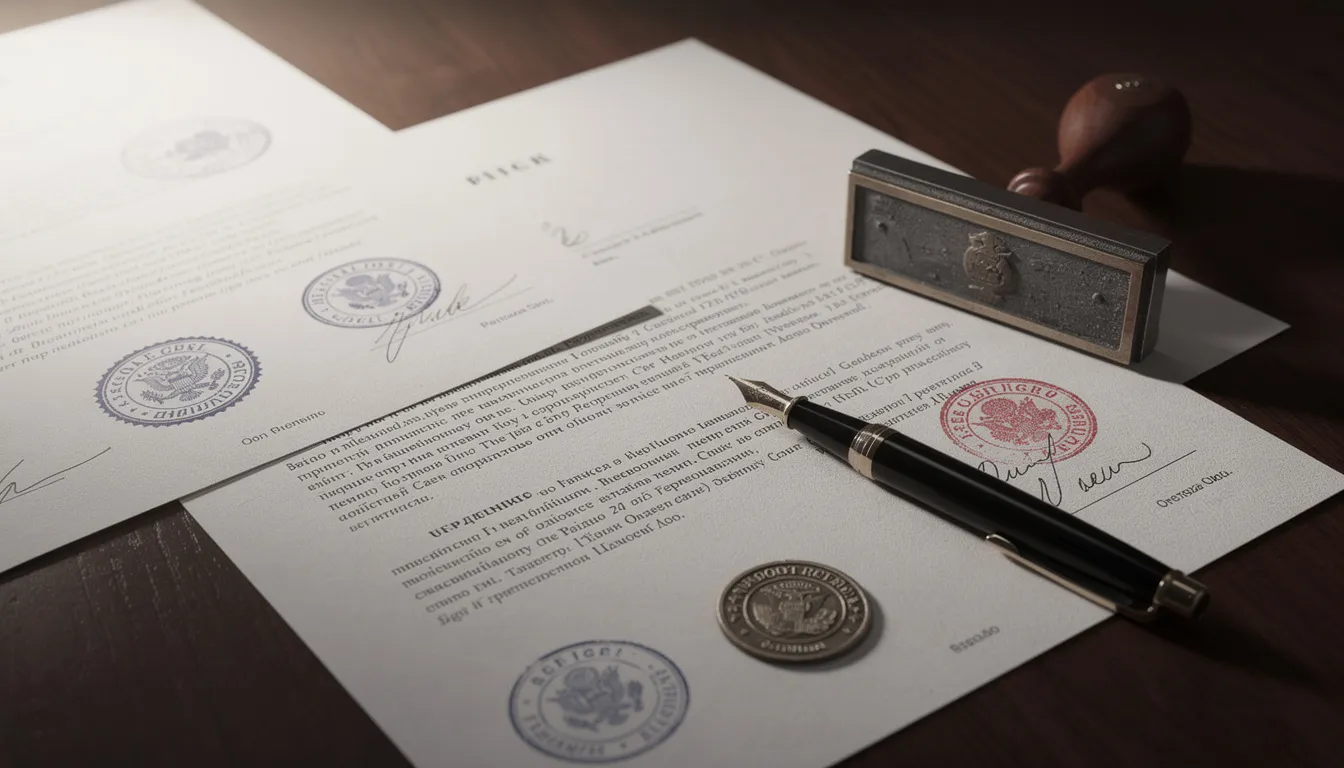
When Do You Need to Legalize a Marriage Certificate?
Several life events trigger the need to have your marriage certificate authenticated for international use. Understanding when this requirement applies helps you plan ahead and avoid last-minute delays.
Immigration and family reunification top the list. If you are sponsoring your spouse for a 2024 visa to Canada, the UK, or Germany, immigration authorities will require proof that your marriage is legally recognized. Long-term residence permits throughout the EU and Asia routinely demand apostilled or legalized marriage certificates issued within a specific timeframe.
Dual citizenship applications in countries like Italy, Ireland, or Portugal often require authenticated vital records going back generations. If you are claiming citizenship by descent, you may need not only your own marriage certificate but also those of parents or grandparents, all properly apostilled.
International name changes and civil registry registrations are another common trigger. For example, if you were married in the U.S. in 2020 and want to register that marriage in the Philippines or Mexico in 2025, you will need a document that their authorities can verify.
Cross-border legal matters create additional requirements. These include inheritance cases involving property in Spain or France, international adoption proceedings, and divorce or separation cases filed abroad. Courts in other countries will not proceed without authenticated marriage records.
Administrative uses are often overlooked until deadlines loom. Opening a joint bank account abroad, completing employer-sponsored relocations, enrolling in health insurance, and qualifying for government benefits or pensions all may require your marriage certificate to be authenticated.
The requesting authority—whether an embassy, immigration office, municipality, or court—usually specifies exactly what they need. They will tell you whether an apostille is sufficient or whether full legalization is required, and they will often state how recent the certificate must be. Many countries require marriage certificates issued within the last 3 to 12 months, so a document from your wedding day may need to be replaced with a fresh certified copy.
Apostille vs. Consular Legalization: Which One Do You Need?
Your path forward depends entirely on whether the destination country is a member of the 1961 Hague Apostille Convention. This treaty, now joined by more than 120 countries, created a standardized system for authenticating documents issued in one member country for use in another.
An apostille is used when both the issuing country (the United States) and the destination country are Hague members. The apostille is a square certificate containing 10 standardized fields, including the country name, the signed authority’s details, and a unique seal. It gets attached directly to your document and certifies that the signature and seal are genuine. No further consular steps are needed.
Consular legalization is the alternative process for non-Hague countries. It involves multiple steps: first your state’s office issues an authentication certificate, then the U.S. Department of State authenticates that, and finally the destination country’s embassy or consulate in the United States legalizes the document by adding their own stamp.
Hague countries that accept apostilles for U.S. marriage certificates include the Netherlands, Spain, Italy, France, Germany, Japan, and Australia. For these destinations, you submit your certified marriage certificate to the Secretary of State in the state where you married, pay the required fee (typically $5 to $45 depending on the state), and receive your apostilled document within days or a few weeks.
Non-Hague countries with different requirements include China, the United Arab Emirates, Qatar, Kuwait, and Vietnam. For these destinations, after obtaining state certification, you must send your document to the U.S. Department of State for federal authentication (an $8 to $20 fee with processing times of 2 to 4 weeks or longer), and then submit everything to the relevant embassy or consulate for final legalization (fees ranging from $30 to over $100, with processing of 3 to 10 business days).
Edge cases exist. Documents intended for use in the Netherlands or Dutch Caribbean territories like Aruba, Curaçao, and Sint Maarten rely on apostilles issued by U.S. authorities. Some consulates have additional language or translation rules that apply even when an apostille is accepted.
Hague Country Process: Obtain certified copy from vital records office or county official → Submit to your state’s Secretary of State for apostille → Receive apostilled document (1 to 3 weeks typical) → Obtain certified translation if required by destination country.
Non-Hague Country Process: Obtain certified copy from vital records office or county official → Submit to your state’s Secretary of State for authentication → Submit to U.S. Department of State for federal authentication (2 to 4+ weeks) → Submit to destination country embassy or consulate for legalization (3 to 10 business days) → Obtain certified translation if required.

Step-by-Step: How to Legalize a U.S. Marriage Certificate for Use Abroad
This section provides the core guidance you need to navigate the apostille process or full legalization for your marriage certificate. Follow these steps in order, and you will avoid the delays that catch many people off guard.
Step 1: Confirm the requirements. Before doing anything else, check the foreign country’s requirements through its consulate, embassy, or immigration authority. Some authorities publish clear document checklists—the Netherlands IND and Spain’s extranjería are known for detailed instructions. Confirm whether they require an apostille alone or full authentication and consular legalization, what recency rules apply to the certificate, and whether translation is mandatory.
Step 2: Obtain a certified copy. Your next task is obtaining a certified marriage certificate from the state vital records office or county clerk where the marriage was recorded. If you married in New York City, you contact the NYC Clerk’s Office. If you married in Los Angeles County, you contact the Los Angeles County Registrar. If you married in Cook County, Illinois, you contact the Cook County Clerk. The certified copy must bear a raised or multicolored seal, the registrar’s signature, and a filing date. This is not the decorative certificate you may have received at your wedding—it is an official document with legal standing. Fees typically range from $15 to $35.
Step 3: Check eligibility for apostille or legalization. Confirm that your certificate is a “long form” or “full” certificate if the foreign authority requires it. The document must bear signatures that the Secretary of State can verify. Unofficial photocopies, hospital keepsakes, or digital printouts without official seals will not work. If your original document was a state issued document bearing proper credentials, you are ready to proceed.
Step 4: State-level certification. For most U.S. marriage certificates, the first legalization stage occurs at the Secretary of State’s office in the state where the marriage was recorded. Texas marriages go to the Texas Secretary of State. California marriages go to the California Secretary of State. Iowa marriages go to the Iowa Secretary of State at a fee of $5 per document plus $2 per page. This office attaches an apostille (for Hague destinations) or an authentication certificate (for non-Hague destinations). Standard processing takes 4 to 14 business days by mail, though many states offer expedited 1 to 3 day service for additional fees.
Step 5: Federal authentication if needed. For non-Hague countries, some consulates require U.S. Department of State authentication in Washington, DC after the state certificate. For example, if you are legalizing a 2021 Florida marriage certificate for use in China or Vietnam, you would send the state-authenticated document to the Office of Authentications, pay the federal fee, and wait for processing. This step typically adds 2 to 4 weeks, sometimes longer during peak periods.
Step 6: Consular legalization (for non-Hague destinations). The final step for non-Hague countries is presenting your document authenticated by the Department of State to the destination country’s embassy or consulate. The UAE Embassy in Washington, DC, or the Chinese Consulate in New York or Los Angeles, will review the document, charge consular fees, and add their own legalization stamp. Processing times are typically 3 to 10 business days, though some embassies only accept applications by appointment or on specific days.
Step 7: Translation. Many countries require sworn or certified translations into their official language. Italy, Spain, and the Netherlands all have translation requirements. Some consulates accept only translations by court-approved translators or notarized documents prepared by a notary public in the destination country. The translation may need to happen after the apostille is attached, or sometimes before, depending on local rules. Translation costs average around $0.10 per word.
Overall timelines vary considerably. A straightforward Hague apostille can often be completed in 1 to 2 weeks. A complex non-Hague route involving state, federal, and consular steps can take 4 to 8 weeks when you include mailing times and appointment availability. Start early if you have a fixed immigration deadline or wedding date abroad.
Special Rules and Examples by State and Country
While the overall concept of legalizing a marriage certificate is similar everywhere, the details differ significantly depending on which state issued your certificate and which country will receive it.
California handles a high volume of apostille requests through the California Secretary of State offices in Sacramento and Los Angeles. County-level marriage certificates must bear the county clerk’s recognizable signature and seal before they can be apostilled. California apostilles typically include a red circular stamp that overlaps both the apostille certificate and the underlying document. Due to volume, standard processing can take up to 60 business days during busy periods, though expedited options are available.
New York has a two-step process that catches many people off guard. Marriage certificates issued in New York City usually require prior certification by the New York County Clerk (or the relevant county clerk for other counties) before the New York Department of State can issue an apostille. The fee is $10 per document, and walk-in service is available in New York City and Albany for those who cannot wait for mail processing.
The Netherlands generally accepts U.S. marriage certificates with a state-issued apostille. However, Dutch authorities—whether the municipality handling your civil registration or the IND processing your residence permit—may have their own rules about how recent the document must be. Some Dutch offices independently verify documents issued in the U.S. by contacting the issuing authority. The apostille ensures your document meets the baseline legal standard for acceptance.
For common immigration destinations like Spain, Italy, Canada, and the UK, authorities typically accept an apostilled U.S. marriage certificate plus a certified translation into the official language. Their consulates publish detailed document checklists that specify authentication certificates requirements, translation standards, and recency limits. Always check these checklists before submitting anything.
Case Study 1: A couple married in Texas in 2020 decided to move to Amsterdam in 2024. They obtained a certified copy of their Texas marriage certificate from the county clerk, submitted it to the Texas Secretary of State for apostille, received the apostilled document within 10 business days, then had it translated into Dutch by a certified translator. Total timeline: about 3 weeks including translation. Total cost: approximately $80 including state fees, shipping, and translation.
Case Study 2: A couple married in Illinois in 2019 needed their marriage certificate for UAE residency in 2025. Their process was longer: Illinois Secretary of State authentication, then U.S. Department of State federal authentication (took 3 weeks), then submission to the UAE Embassy in Washington with a mailing address for return. Total timeline: about 6 weeks. Total cost: approximately $250 including all fees and courier services.
How to Legalize a Foreign Marriage Certificate for Use in the USA
If you were married outside the United States—whether in Mexico, the Philippines, Germany, or elsewhere—your foreign marriage certificate may need to be legalized before U.S. agencies or courts will accept it. Immigration services like USCIS, state courts, the Social Security Administration, and DMVs all have documentation requirements.
Step 1: Follow the issuing country’s legalization process. The foreign certificate must first be legalized or apostilled in the country where the marriage took place. This often involves that country’s Ministry of Justice, Ministry of Foreign Affairs, or local registrar’s office. Each country has different requirements for this step—Italy has its own process, as do Brazil, the Philippines, and every other nation.
Step 2: Use apostille for Hague countries. If the foreign country is a Hague member (such as Italy, France, Brazil, or Germany), an apostille from that country is usually sufficient for U.S. use. The apostille attached by the foreign government certifies that the document was genuinely issued by their authorities.
Step 3: Consular or embassy legalization for non-Hague countries. For non-Hague countries (such as the United Arab Emirates, Qatar, or most African states), additional certification at the U.S. embassy or consulate in that country may be required before the document will be accepted in the U.S. U.S. embassies abroad can authenticate the signatures of foreign officials on your document.
Step 4: Certified translation into English. Virtually all U.S. authorities require a complete certified English translation of the marriage certificate and any apostille or legalization stamps. The translation must be accompanied by a certificate stating that the translator is competent in both languages and that the translation is accurate. This applies whether you are dealing with USCIS, Social Security, state courts, or employers.
Step 5: Presenting the document in the USA. These legalized documents are needed for various purposes: USCIS spousal petitions (Form I-130), Social Security name changes, state-level name change proceedings, divorce certificates, and employer immigration filings. Courts handling international adoption or divorce proceedings also require authenticated foreign documents.
The United States does not have a nationwide system for “registering” a foreign marriage. Recognition is based on whether the marriage was valid where it was celebrated and is not contrary to strong U.S. public policy. A marriage that was legally recognized in Germany or Mexico is generally recognized in the U.S., provided you can prove it occurred with properly authenticated documents issued by the foreign country.
Using Professional Legalization and Apostille Services
While individuals can complete the legalization process on their own, many choose specialized apostille services to avoid rejection and save time. The process involves multiple offices, each with their own forms, fees, and quirks—mistakes are easy to make.
A professional service typically helps by confirming whether apostille or full authentication is needed based on your destination country, verifying that your document is eligible (proper seals, signatures, and format), preparing state, federal, and consular applications correctly, and arranging secure courier or in-person filing at each office.
These services can often obtain state apostilles within a few business days using expedited processing or in-person submission. For complex routes—such as a Texas certificate needing Texas Secretary of State authentication, then U.S. Department of State authentication, then UAE Embassy legalization—a service handles the entire chain without requiring you to visit any office in person.
Professional providers stay current with rule changes that can trip up individuals. This includes updated request forms, new payment requirements (like CVV on credit card authorization forms), altered embassy processing hours, and changed mailing addresses. What worked six months ago may not work today.
When evaluating a provider, look for clear pricing without hidden fees, realistic timelines based on current processing speeds, tracking of important documents through each stage, and direct customer support that can answer questions about your specific destination country’s requirements.
Before engaging a service, prepare scans of your certificate and any instructions you have received from the foreign authority. This allows the service to verify the correct route before you mail any original document. Some services have online portals where you can upload documents for pre-audit, catching issues like name mismatches or expired seals before they cause rejection.

Common Mistakes and How to Avoid Them
Many legalization problems come from using the wrong type of certificate or sending documents to the wrong authority. Understanding these pitfalls helps you avoid rejection and wasted time.
Document format errors are the most common cause of rejection. Submitting a photocopy or uncertified copy instead of an original or certified copy will get your request returned unprocessed. Missing the required fee, omitting the registrar’s signature, or using an outdated short-form certificate when the foreign authority demands a long form all cause problems. The certificate must be a valid official document, not a decorative keepsake.
Timing problems catch many people. Some European immigration offices require a certificate issued within the last 6 months. If you use a certified copy that is too old, you may need to obtain a fresh one and restart the entire process. Waiting too long before a consular appointment can also cause your document to “expire” under the destination country’s rules. Birth certificates, death certificates, divorce certificates, and other vital records face similar recency requirements.
Procedural errors waste significant time and money. Requesting an apostille for a non-Hague country that actually requires full authentication and consular legalization is a common mistake. Failing to authenticate a notary public’s signature when the state requires it for notarized documents is another. Sending your original document to the wrong state’s office results in it being returned—you must submit to the state’s office where the marriage was recorded.
Prevention tips include verifying requirements directly with the requesting office before starting, double-checking that names and the date on the certificate match your passport exactly (name mismatches cause 20-30% of rejections according to service providers), keeping copies of every document and receipt, and using trackable mail or courier services for all original documents.
Consulting an expert early usually costs far less than fixing a rejected or expired file later. If you are in the middle of an immigration process or legal proceeding, a rejected document can delay your case by months while you obtain additional certification and resubmit. The few hundred dollars spent on professional help often saves thousands in delayed relocation costs or missed opportunities.
FAQ
This FAQ covers additional questions not fully addressed in the main sections above. Each answer provides practical guidance you can act on immediately, though exact requirements vary by state and destination country.
How long does it take to legalize a marriage certificate for use in another country?
State-level apostilles can take anywhere from same-day service at walk-in offices to 2 to 3 weeks by mail, depending on the state and season. California can take up to 60 days during peak periods, while Iowa typically processes in 4 to 14 business days standard or 1 to 3 days expedited.
Adding U.S. Department of State authentication typically adds 2 to 4 weeks by mail, sometimes longer during peak periods or security backlogs. Consular legalization adds another 3 to 10 business days, with some embassies only accepting applications on specific days or by appointment.
Overall, a straightforward Hague apostille can often be completed in 1 to 2 weeks. A complete non-Hague route involving state, federal, and consular steps can take 4 to 8 weeks or more when you include planning and mailing times. If you have a fixed immigration deadline or wedding date abroad, start the process at least 2 to 3 months before you expect to submit your documents to the foreign authority.
Can I legalize a digital or photocopied marriage certificate?
Most authorities require an original or certified copy issued by the vital records office or county clerk, not a home printout or simple photocopy. Sending in the wrong document format is one of the most common reasons apostille or legalization requests get returned unprocessed.
Some states now issue “digitally certified” records with electronic verification codes. However, many foreign authorities still insist on a traditional paper certificate with a visible raised seal and signature. Photocopies can sometimes be notarized and then apostilled, but only when the destination country specifically accepts notarized copies instead of original vital records.
Always ask the foreign authority whether they will accept notarized copies. When in doubt, obtain a fresh certified original from the issuing state to avoid rejection. The cost of a new certified copy ($15 to $35) is far less than the cost of starting over after a rejection.
Do same-sex marriages require a different legalization process?
The apostille or legalization process itself is identical for same-sex and opposite-sex marriages. The issuing state and certifying authorities treat the marriage certificates issued the same way regardless of the genders of the spouses.
Differences arise with the destination country’s recognition policies. Some countries fully recognize same-sex marriages for immigration and civil status purposes (most EU nations including the Netherlands and Spain), while other countries do not (many Middle Eastern and African nations, as well as some Asian countries).
Before investing time and money in legalizing your certificate, check both the legalization requirements and the legal recognition rules of the destination country. Even where full recognition is not granted, some authorities may accept the certificate for limited purposes such as proof of relationship for visa processing. Getting written guidance from the relevant consulate or immigration authority protects you from surprises. Consider consulting an immigration or family-law professional familiar with LGBTQ+ cross-border issues when moving to countries with restrictive laws.
How recent does my marriage certificate need to be for legalization?
U.S. authorities rarely impose strict recency rules for issuing apostilles—they will generally apostille any valid certified copy regardless of when it was issued. However, foreign authorities frequently impose recency requirements.
Some European immigration offices and municipalities require marriage certificates issued within the last 3 or 6 months. German and Dutch authorities may accept certificates up to 12 months old, while other countries have no stated limit. For countries without clear published guidance, using a certificate issued within the last 6 months is safer and reduces the risk of having to redo the complete process later.
The date that matters is typically the issuance date printed on the certified copy, not the date of the original marriage. Always verify recency requirements directly with the requesting office (embassy, consulate, or immigration authority) before investing time and money in legalizing an older certificate. This additional information can save you from a frustrating and expensive rejection.
Can I use one legalized marriage certificate in multiple countries?
Once a marriage certificate has an apostille from the issuing state, it can typically be accepted in any Hague Convention country without additional apostilles, provided it remains within any recency limits imposed by each country. A Texas apostille is valid for use in Spain, the Netherlands, Italy, Germany, and any other states that are Hague members.
Consular legalizations are usually destination-specific. A certificate legalized for the UAE may not be automatically accepted by China or another non-Hague country without completing their separate legalization process.
Repeated handling can damage original documents. Many people order several certified copies from the county official or vital records office at the outset so each can be legalized separately for different destinations. Keep at least one certified copy unused as a spare, particularly when planning future moves or citizenship applications.
Translation requirements may still differ from country to country even when the underlying apostille is accepted globally. Spain requires Spanish translation, Italy requires Italian, and the Netherlands may require Dutch for certain proceedings. Contact each destination country’s consulate to verify their specific requirements before assuming one legalized document will work everywhere.
