

Key Takeaways
- A driver’s license apostille is an official certification that authenticates your U.S. driver’s license for use in foreign countries that are part of the Hague Apostille Convention
- You must submit a notarized copy of your driver’s license, never the original document, to the Secretary of State in the state where your license was issued
- The apostille process typically takes 5-15 business days depending on the state, though expedited same-day services are available in some locations
- Countries like the UK, France, Germany, Australia, and over 120 other Hague Convention members will recognize your apostilled driver’s license
- Without an apostille, your U.S. driver’s license may not be accepted for car rentals, residence permits, or other legal purposes abroad
Whether you’re planning to study abroad, relocate for work, or establish permanent residence in another country, your U.S. driver’s license may need international authentication to be recognized as valid. This is where a driver’s license apostille becomes crucial for your international mobility.
An apostille certificate serves as an official stamp of authenticity that makes your personal documents legally recognized in foreign countries. Under the Hague Apostille Convention framework, this standardized process eliminates the complex embassy authentication procedures that were once required for international document verification.
This comprehensive guide will walk you through everything you need to know about obtaining a license apostille, from understanding when you need one to navigating state-specific requirements and avoiding costly mistakes that could delay your international plans.
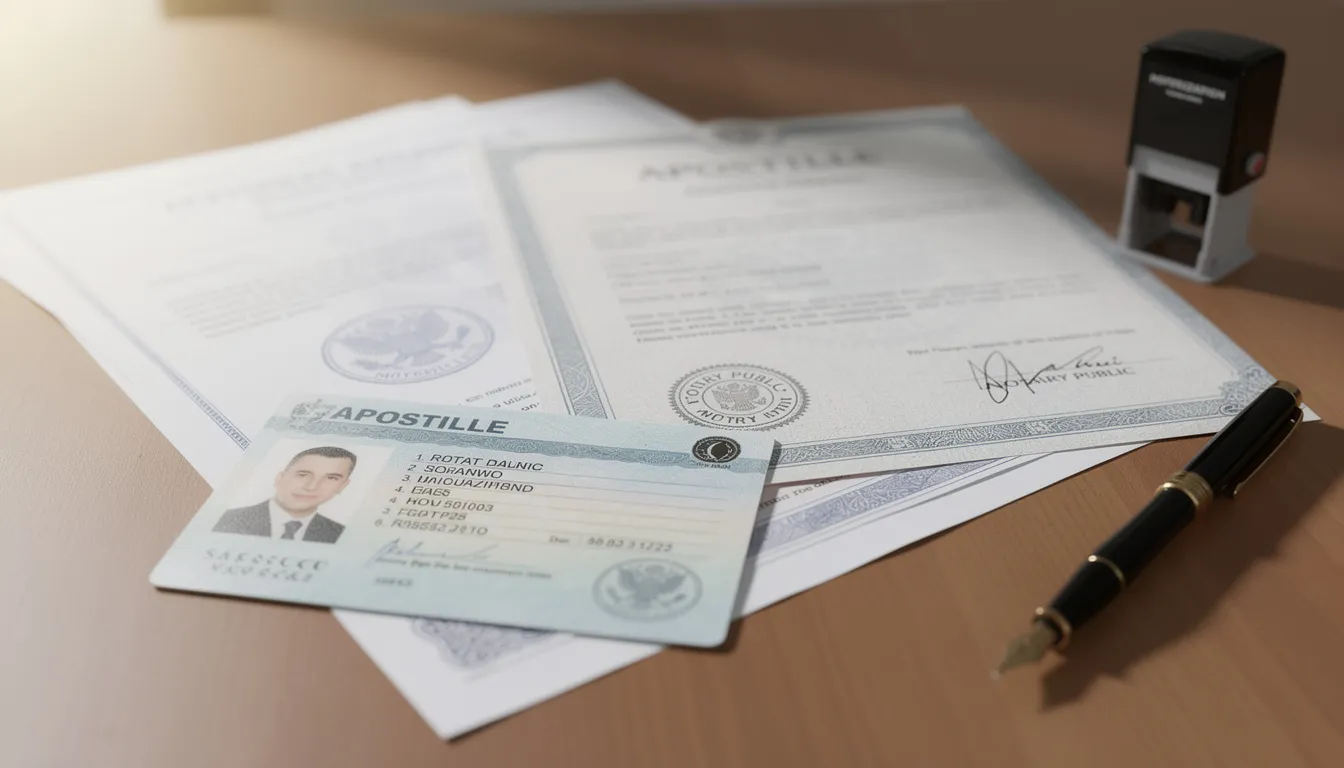
What Is a Driver’s License Apostille
A driver’s license apostille is an official certification that validates the authenticity of your U.S. driver’s license for international use. This certificate doesn’t verify the content of your license but confirms that the notary public who certified your document copy has legitimate authority to perform notarization in their state.
The legal foundation for apostille certification stems from the Hague Apostille Convention of 1961, an international treaty that standardized document authentication between member countries. When a state’s office attaches an apostille certificate to your notarized driver’s license copy, it creates a chain of trust that foreign authorities can easily verify and accept.
The key difference between apostille and embassy authentication lies in the destination country. If you’re traveling to a Hague Convention member nation, a single apostille from the appropriate Secretary of State office will suffice. However, for non-Hague Convention countries, you’ll need the more complex embassy authentication process, which typically involves multiple levels of verification through the U.S. Department of State and the destination country’s embassy.
An apostille certificate contains standardized information including the country of origin, the name and capacity of the person who signed the document, the seal or stamp identification, the date of certification, and the issuing authority’s official seal. This uniform format ensures that officials worldwide can quickly recognize and trust the document’s authenticity. For those seeking visa apostille services in Germany, understanding the apostille process and its standardized nature is essential.
When You Need a Driver’s License Apostille
Understanding when to obtain an apostille for your driver’s license can save you significant time and frustration during international transitions. The most common scenarios requiring this certification extend beyond simply driving in foreign countries.
Moving abroad permanently often triggers requirements for authenticated identity documents. When establishing legal residence in countries like Spain, Italy, or Germany, immigration authorities frequently request apostilled personal documents as part of the residency application process. Your driver’s license serves as crucial proof of identity and residence history that supports your immigration file.
Applying for work visas or residence permits in many countries requires comprehensive documentation packages. Employment-based immigration processes often demand multiple forms of identity verification, and an apostilled driver’s license can strengthen your application by providing additional authenticated proof of your background and legal status in the United States.
Vehicle-related activities abroad represent another major use case. While an International Driving Permit handles short-term driving privileges, converting your U.S. license to a local driver’s license in countries like Australia or the United Kingdom often requires apostille certification. Additionally, some international car rental companies and insurance providers request apostilled licenses to verify authenticity and reduce fraud risk.
University admission requirements for international students may include requests for authenticated driving credentials, especially for programs that involve field work, internships, or research that requires transportation access. Some universities also request apostilled documents as part of their comprehensive identity verification procedures.
The important distinction to remember is that an apostille certificate verifies your license’s authenticity but doesn’t automatically grant driving privileges in foreign countries. Each nation maintains its own traffic laws and licensing requirements that determine how long foreign licenses remain valid and whether additional permits or local licenses are needed.
The Driver’s License Apostille Process
The apostille process follows a specific sequence that begins well before you contact any state office. Understanding each step ensures smooth processing and helps you avoid the common mistakes that lead to delays or rejections.
Timeline expectations vary significantly depending on your chosen method and state requirements. Standard processing typically takes 5-15 business days from the date your complete application reaches the appropriate Secretary of State office. However, expedited services can reduce this timeframe to same-day processing in some states, though premium fees apply for rush services.
Required forms and application materials include a completed apostille request form specific to your state, the notarized copy of your driver’s license, appropriate fees, and a return shipping method with tracking. Most states provide downloadable order forms on their official websites, though some still require paper applications submitted by mail or in person.
Payment methods accepted vary by state but commonly include money order, certified check, or credit card payments. Cash payments are typically only accepted for in-person submissions. Fee structures range from $10-50 depending on the state and processing speed you select, with expedited services commanding premium pricing.

Document Preparation Requirements
Proper document preparation forms the foundation of successful apostille processing. The quality and accuracy of your submitted materials directly impact processing speed and approval likelihood.
Creating high-quality color copies of both the front and back of your driver’s license is essential. The copy must clearly display all text, numbers, photographs, and security features. Blurry, cropped, or black-and-white copies frequently result in rejection and processing delays. Use a high-resolution scanner or professional copy service to ensure optimal quality.
Finding a licensed notary public must occur in the state where your license was issued, not where you currently reside. This requirement often surprises people who have moved since obtaining their license. The notary public must be currently licensed and in good standing with their state’s notarial authority. Many banks, law offices, and shipping stores provide notary services, though calling ahead to confirm availability is recommended.
Proper notarization procedure requires the notary to certify that your copy represents a true and correct reproduction of the original document. The notary public must affix their official seal, provide their signature, include the date of notarization, and specify their commission expiration date. The notarial certificate should explicitly state that the attached copy is a faithful reproduction of the original driver’s license presented to them.
Protecting your original license is crucial throughout this process. Never submit your actual plastic driver’s license for apostille processing. States process apostilles on copies only, and submitting an original document typically results in rejection and potential loss of your primary identification. Keep your original document secure while the apostille process proceeds.
State Authority Submission
Navigating state-specific submission requirements requires careful attention to procedural details that vary significantly across jurisdictions. Submitting to the wrong office or using incorrect procedures can add weeks to your processing timeline.
Identifying the correct Secretary of State office depends entirely on where your license was issued, regardless of your current location. A California-issued license must be apostilled by the California Secretary of State office, even if you currently live in New York or overseas. Each state maintains its own apostille department with specific contact information, office hours, and submission procedures.
Completing state-specific apostille application forms requires accurate information about your destination country, contact details, and return shipping preferences. The destination country field is particularly critical because it determines whether the state issues an apostille certificate (for Hague Convention members) or an authentication certificate (for non-Hague countries). Providing incorrect or incomplete information can result in receiving the wrong type of certification.
Submission methods include in-person appointments, mail-in services, or authorized third-party processors. In-person submission often provides the fastest processing times and allows immediate clarification of any questions. Mail-in services require careful packaging and use of mail tracking service to monitor your document’s journey. Some states authorize specific companies to accept submissions on behalf of applicants, which can expedite processing for urgent requests.
Special considerations for Washington D.C. apply to certain federal district situations, though most driver’s licenses are state-issued documents processed through state authorities rather than federal agencies. However, if you need to apostille multiple documents simultaneously, understanding which level of government issued each document ensures proper routing of your apostille request.
State-Specific Apostille Requirements
Each state maintains distinct procedures, fee structures, and processing capabilities that significantly impact your apostille timeline and experience. Understanding your specific state’s requirements helps you plan effectively and avoid unnecessary delays.
California Secretary of State processes apostille requests through their Sacramento office with typical processing times of 5-7 business days for standard service. California accepts online submissions for certain document types and offers same-day processing for in-person requests submitted before noon on business days. The state charges $20 per apostille certificate as of 2024, with expedited services available for additional fees.
Texas apostille procedures operate through the Austin-based Secretary of State office with a standard fee of $15 per document. Texas provides both mail-in and walk-in services, with expedited processing available for urgent requests. The state requires specific formatting for apostille requests and accepts payment by money order, certified check, or credit card for mail-in submissions.
New York processing occurs through the Albany office of the Department of State, which operates an appointment scheduling system for in-person submissions. For example, if you need to authenticate a document such as your California driving record, New York offers same-day service for appointments scheduled in advance and charges $10 per apostille certificate. The state provides detailed instructions for mail-in submissions, including specific packaging requirements and return envelope specifications.
Florida walk-in services are available at the Tallahassee Secretary of State office during regular business hours without appointment requirements. Florida charges $20 per apostille and typically completes same-day processing for in-person submissions. The state also accepts mail-in requests with a standard processing time of 7-10 business days.
Special procedures for Washington D.C. residents may involve coordination between different government levels depending on the specific document type. While driver’s licenses are state-issued documents, D.C. residents should verify the correct processing authority for their particular situation.
Each state maintains updated fee schedules, processing times, and submission requirements on their official websites. Checking current information before beginning your apostille process helps ensure compliance with the latest procedures and prevents processing delays.
International Use and Country Acceptance
Understanding which countries accept apostilled U.S. driver’s licenses and their specific requirements helps you determine whether this authentication method meets your international needs.
Hague Convention member countries currently include over 120 nations that recognize apostille certificates as sufficient authentication. Major destinations include the United Kingdom, Germany, France, Italy, Spain, Australia, Canada, Japan, and most European Union member states. This extensive network covers the majority of popular destinations for American expatriates, students, and business professionals.
Country-specific requirements for license conversion vary significantly even among Hague Convention members. The United Kingdom, for example, accepts apostilled U.S. licenses as part of their license exchange program for certain states, allowing direct conversion without retesting. Germany requires apostilled licenses for their conversion process but may also mandate additional documentation such as certified driving records showing violation history.
Temporary driving privileges versus permanent license exchange represent different use cases for apostilled licenses. Many countries allow short-term driving on foreign licenses (typically 30-90 days) without apostille certification, relying instead on International Driving Permits. However, permanent residents or long-term visitors often must convert to local licenses, which frequently requires apostille authentication of their U.S. credentials.
Embassy authentication process for non-Hague Convention countries like China, United Arab Emirates, and Vietnam requires a more complex multi-step procedure. Instead of a simple apostille, documents must receive state authentication, federal authentication through the U.S. Department of State, and final legalization through the destination country’s embassy or consulate. This process can take several weeks or months and involves significantly higher costs.
Translation requirements and certified translator specifications apply in many non-English speaking countries, even those that accept apostilles. Countries like Spain, Germany, and Japan typically require official translations of apostilled documents performed by certified translators recognized by their governments. Some nations specify that translations must be completed by sworn translators licensed in the destination country rather than in the United States.
Planning for these varying international requirements ensures your apostilled driver’s license will serve its intended purpose when you arrive in your destination country. Research specific requirements well in advance, as additional steps like translation or supplementary documentation can add weeks to your preparation timeline.
Professional Apostille Services vs DIY
Deciding between handling the apostille process yourself or hiring professional apostille services involves weighing cost, convenience, risk tolerance, and timeline considerations that vary based on your specific situation.
Advantages of using professional services include expertise in navigating state-specific requirements, handling of all logistics from notarization through delivery, and insurance protection against document loss or processing errors. Companies like Monument Visa, Apostille.net, and numerous local service providers specialize in document authentication and maintain current knowledge of changing state requirements and processing procedures.
Professional services typically offer package deals that include notarization, state submission, tracking, and international delivery. They often maintain relationships with state offices that can facilitate faster processing and provide immediate resolution of any issues that arise. For individuals currently overseas or those juggling multiple document types, professional services can manage the entire process remotely.
Cost comparison analysis shows significant differences between DIY and professional approaches. Handling the process yourself typically costs $15-50 in state fees plus notarization costs ($10-25), shipping expenses, and your time investment. Professional services charge $75-200 per document including all fees, notarization, processing, and delivery to your specified address worldwide.
The cost difference becomes less significant when factoring in the value of your time, the risk of mistakes requiring resubmission, and the convenience of guaranteed delivery. For urgent situations requiring expedited processing, professional services often provide access to same-day services that individuals cannot obtain independently.
Same-day expedited services are available in major metropolitan areas including Los Angeles, Houston, Miami, Washington D.C., and New York. These services typically require submission by specific morning deadlines and command premium pricing of $200-400 per document. Some professional services maintain walk-in offices near state capitals specifically to provide rapid turnaround for urgent requests.
Online upload systems offered by many professional services allow digital submission of document scans for initial review and processing preparation. These systems typically include status tracking portals where clients can monitor their apostille request progress in real-time. Some services provide mobile apps that send push notifications for processing milestones and delivery confirmation.
Insurance and guarantee policies provided by reputable apostille companies protect against document loss, processing errors, and delivery failures. Many services offer money-back guarantees if documents are rejected due to their processing mistakes and provide replacement services at no additional charge. This protection can be particularly valuable when dealing with original certified copies or tight deadline situations.
The decision between DIY and professional services often depends on your comfort level with bureaucratic processes, current location, timeline flexibility, and budget considerations. Individuals currently abroad or those managing multiple documents frequently find professional services more practical despite the higher cost.
Timeline and Planning Considerations
Effective timeline planning for your driver’s license apostille prevents delays that could disrupt international travel plans, job starts, or academic program deadlines. Understanding the various factors that influence processing speed helps you build realistic schedules.
Recommended timeline guidelines suggest starting your apostille process 30-60 days before you need the authenticated document. This timeframe accommodates standard processing delays, potential resubmissions due to errors, and international shipping time if you’re already abroad. For critical deadlines like visa applications or job start dates, beginning the process 90 days in advance provides additional buffer time.
Peak processing seasons significantly impact state office workloads and processing speeds. Summer months from June through August typically see increased volume as students prepare for fall academic programs abroad. Similarly, the period from November through January experiences higher demand as individuals prepare for new year relocations and business transfers. During these peak periods, standard processing times can extend beyond normal ranges.
Emergency processing options are available in most states but come with strict limitations and premium pricing. Same-day processing typically requires in-person submission by specified morning deadlines and may not be available during peak seasons or holidays. Some states offer expedited mail-in services that guarantee processing within 2-3 business days for additional fees.
Document validity periods vary by destination country rather than by apostille expiration dates. The apostille certificate itself doesn’t expire, but many foreign authorities impose their own freshness requirements ranging from 3-12 months from issuance date. Countries with stricter requirements may require recently issued apostilles even for documents that remain valid indefinitely.
Backup documentation strategies should be part of your planning process, especially for critical applications. Consider apostilling multiple copies of your driver’s license if you anticipate needing authenticated documents for multiple purposes abroad. Some individuals also obtain apostilles for related documents like certified driving records or FBI background checks that could serve as alternatives if primary documents are delayed or rejected.
Planning for potential complications like state office closures, weather-related delays, or international shipping disruptions helps ensure your timeline remains manageable even when unexpected issues arise.
Common Mistakes to Avoid
Learning from typical errors made during the apostille process can save you weeks of delays and additional expenses that result from rejected applications or incorrect submissions.
Sending original driver’s license instead of notarized copy represents the most frequent and costly mistake in apostille applications. State offices consistently reject original documents because apostilles are attached to copies, never originals. Submitting your actual license risks permanent loss of your primary identification document and guarantees processing rejection.
Using notary public from wrong state occurs when people assume they can notarize documents anywhere rather than in the license-issuing state. A California driver’s license must be notarized in California by a California-licensed notary, regardless of where you currently live. This requirement often necessitates coordinating with a family member or trusted contact in your original state to handle notarization on your behalf.
Incomplete apostille applications missing required signatures, incorrect destination country information, or inadequate return shipping instructions result in processing delays or rejections. Each state maintains specific form requirements that must be completed accurately. Providing incorrect destination country information can result in receiving an authentication certificate instead of an apostille, necessitating resubmission with correct information.
Assuming all countries accept apostilled documents leads to inappropriate document preparation for non-Hague Convention destinations. Countries like China, Thailand, and several Middle Eastern nations require embassy authentication rather than apostille certification. Using the wrong authentication method means starting the process over with different procedures.
Waiting until last minute before international travel creates unnecessary stress and may force expensive expedited processing or emergency service fees. International document authentication inherently involves multiple parties and potential complications that cannot be rushed without significant additional cost.
Other frequent errors include submitting temporary or digital driver’s licenses that many states cannot notarize, providing poor-quality copies where text and images are unclear, failing to include proper return postage or shipping labels, and assuming processing times remain constant during peak seasons or holidays.
Creating a checklist that covers document quality, notarization requirements, state-specific procedures, and shipping specifications helps prevent these common mistakes that can derail your apostille timeline.
Frequently Asked Questions
Can I apostille an expired driver’s license?
Yes, you can obtain an apostille for a copy of an expired driver’s license as long as it’s properly notarized by a licensed notary public in the issuing state. The apostille certificate authenticates the notary’s signature and seal rather than the current validity of the license itself.
However, some destination countries may require your license to be currently valid at the time of use for certain purposes like vehicle registration or license conversion. Consider renewing your license before beginning the apostille process if you plan an extended international stay or need to establish driving privileges abroad.
What if I lost my driver’s license but need an apostille?
If you’ve lost your driver’s license, you must first obtain a replacement from your state’s Department of Motor Vehicles before pursuing apostille certification. Alternatively, you can request a certified driving record from your state DMV, which often contains more comprehensive information than a standard license and can be apostilled in place of a license copy.
Certified driving records show your complete driving history, violation records, and license status, which some foreign authorities prefer over simple license copies. Contact your state DMV to determine which document best serves your international requirements.
Do I need to apostille both my license and driving record?
Requirements vary by destination country and your intended purpose abroad. Some nations require comprehensive driving records showing violation history and license status for permanent license conversion, while others accept simple license copies for temporary driving privileges or identity verification.
Consult with the embassy or legal advisors in your destination country to determine specific documentation requirements. In cases of uncertainty, obtaining apostilles for both documents provides flexibility for varying requirements you might encounter abroad.
How long is an apostilled driver’s license valid?
The apostille certificate itself doesn’t have an expiration date and remains valid indefinitely as an authentication tool. However, destination countries often impose their own validity requirements, typically accepting apostilled documents for 6-12 months from the issuance date.
Check with local authorities or legal advisors in your destination country for specific time limits that apply to your situation. Some countries require “fresh” apostilles for certain procedures even though the underlying document remains valid.
Can I use my apostilled U.S. license to drive immediately in another country?
Not necessarily. An apostilled driver’s license verifies authenticity but doesn’t automatically grant driving privileges in foreign countries. Many nations require International Driving Permits (IDP) for temporary driving, regardless of whether your license is apostilled.
Apostilled licenses are typically used for administrative purposes like permanent residence applications, license conversion procedures, or identity verification rather than immediate driving privileges. Obtain both an IDP and apostilled license for comprehensive international driving coverage, and research specific driving requirements in your destination country.
