

Key Takeaways
- You only need an apostille when a public document will be used in a foreign country that is a member of the 1961 Hague Apostille Convention—currently over 125 jurisdictions worldwide.
- For non-Hague countries (such as the United Arab Emirates, Qatar, or Vietnam), you typically need authentication or consular legalization instead, which involves multiple steps through embassies.
- Common documents requiring apostilles include birth certificates, marriage certificates, death certificates, FBI background checks, diplomas, powers of attorney, and company formation documents.
- Apostilles are issued by government authorities like a Secretary of State or the U.S. Department of State—notaries themselves cannot issue apostilles.
- The quickest way to know if you need an apostille is to identify the destination country, check if it’s on the Hague list, then confirm the exact document requirement with the foreign authority requesting it.
Do I Actually Need an Apostille? (Answer This First)
Will your document be used outside your country? Is that destination country on the Hague Apostille Convention list? If both answers are yes, you almost certainly need an apostille.
You typically need an apostille when a public document—such as a 2020 New York birth certificate, a 2022 California marriage certificate, or a 2023 university diploma—will be presented to authorities in a Hague Convention country like Spain, Italy, France, or Japan. The apostille serves as the internationally recognized authentication certificate that confirms your document is legitimate.
If your destination is a non-Hague country (UAE, Qatar, Vietnam, or most African states that remain non-members in 2024), then you usually do not need an apostille. Instead, you’ll follow a multi-step authentication and legalization process through embassies and consulates. Getting an apostille for these countries would waste your time and money since they won’t accept it.
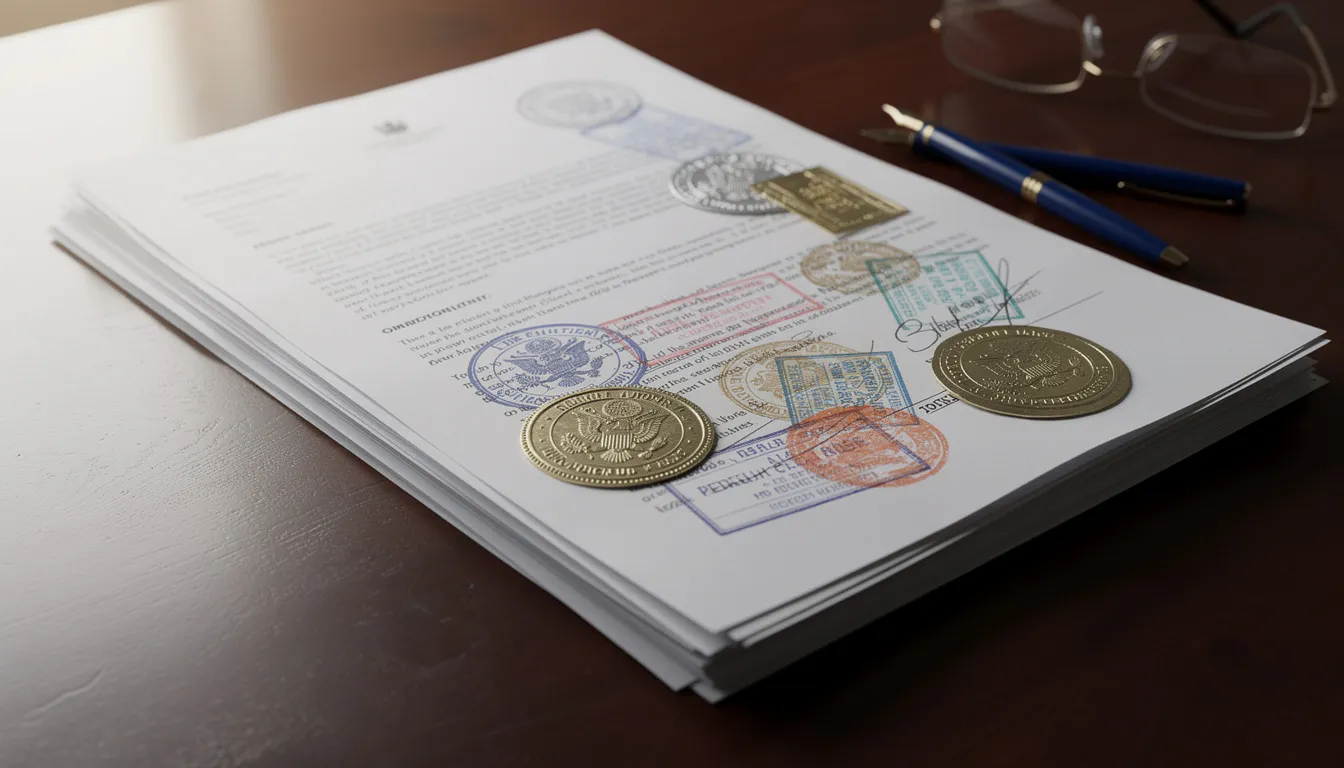
Here are three concrete scenarios:
- Moving to France in 2025 and registering a marriage: You need an apostille. France has been a Hague member since 1965, so your U.S. marriage certificate with an apostille from your state’s Secretary of State will be accepted for civil registration.
- Opening a company branch in Portugal in 2024: You need an apostille. Portugal requires apostilled articles of incorporation and certificates of good standing for foreign business registrations.
- Applying for a UAE investor visa in 2024: You do NOT need an apostille. The UAE is not a Hague member, so you’ll need full authentication through the U.S. Department of State followed by legalization at the UAE embassy.
Quick self-diagnostic checklist:
- Identify your destination country and check its Hague Convention membership status
- Confirm your document type qualifies as a public document (vital records, court documents, notarized documents, or official certificates)
- Review the requesting foreign authority’s exact instructions—they’ll specify whether an apostille or authentication certificate is required
What Is an Apostille and How Does It Work?
An apostille is a government-issued certificate that confirms the authenticity of a public document so it can be recognized in another Hague Convention country. Think of it as an international stamp of approval that tells foreign government officials, “Yes, this document is genuine,” and reflects the broader meaning and function of apostilles in international law.
The apostille does not validate the content of your document. It won’t verify whether the information in your birth certificate is accurate or whether a contract is fair. Instead, the apostille work focuses on three specific elements: verifying the genuineness of the signature on the document, confirming the official seal or stamp is authentic, and establishing that the person who signed had the legal authority to do so.
Apostilles are standardized under the 1961 Hague Convention and typically appear as a separate page attached to your original document. This page is titled “Apostille (Convention de La Haye du 5 octobre 1961)” and includes an issue date, unique reference number, and the official seal of the competent authority.
Documents that commonly have apostilles attached include:
- Certified vital records issued by state offices—birth certificates, marriage certificates, and death certificates
- Court documents such as divorce decrees, custody orders, and judgments
- Notarial acts including powers of attorney, affidavits, and sworn statements
- Corporate documents like articles of incorporation, certificates of good standing, and board resolutions
- Academic records such as diplomas, transcripts, and degree certifications
What Is the Hague Apostille Convention?
The Hague Convention Abolishing the Requirement of Legalisation for Foreign Public Documents—commonly called the Hague Apostille Convention or simply the Hague Convention—was drafted in 1961 to solve a frustrating problem in international document recognition, and understanding the Hague Apostille Convention framework explains why apostilles replaced traditional legalization in member countries.
Before this international treaty, getting a document accepted in a foreign country required a lengthy chain of authentications. You’d start with local notarization, move through state certification, federal authentication, and finally embassy legalization. This traditional procedure could take months and cost hundreds of dollars per document.
The Hague Convention replaced this cumbersome process with a single apostille. One country issues the apostille, and another country accepts it—no embassy visits required. This international treaty streamlined what was previously a bureaucratic nightmare into a manageable administrative task and highlights the Hague apostille’s purpose and global significance.
Recent developments have expanded the Convention’s reach:
- China implemented the Apostille Convention on November 7, 2023, enabling apostilles to replace consular legalization for documents going to or from China. This shift affects over 1.4 billion people and has notably eased business expansions and personal relocations.
- Canada fully implemented the Convention in 2024 across all provinces and territories. This harmonized document flows between Canada, the U.S., and EU countries, streamlining processes like cross-border real estate transactions and student visas.
Each member country designates “competent authorities” responsible for issuing apostilles. In the United States, these include state-level Secretaries of State for state and local documents, and the U.S. Department of State for federal documents like FBI background checks. Other countries may use their Foreign Affairs ministries, courts, or central registries.
You can verify up-to-date membership and find competent authorities through the official Hague Conference on Private International Law (HCCH) website, which maintains the authoritative status tracker for all contracting states.
Which Countries Accept Apostilles?
Apostilles are only valid between countries that are both parties to the 1961 Hague Apostille Convention. As of early 2026, more than 125 contracting states and territories participate in this system.
If either the country where your document originated or the destination country is not a Hague member, an apostille will not be accepted. You’ll need to pursue alternative authentication through embassy legalization instead.
Major Hague member countries by region include:
North America:
- United States (joined October 15, 1981)
- Canada (implemented 2024)
- Mexico
Europe:
- United Kingdom, Germany, France, Italy, Spain, Netherlands, Ireland, Portugal, Belgium, Austria, Switzerland, and most other EU countries
South America:
- Brazil, Argentina, Chile, Colombia, Peru, Ecuador
Asia-Pacific:
- Japan, South Korea, India (limited application), Australia, New Zealand, China (effective November 7, 2023)
Other regions:
- Turkey, Israel, South Africa, Morocco
Country membership can change as new nations accede to the Convention. Before submitting important documents for a 2025 immigration application or study program, always verify the current status of your destination country. The HCCH database provides the most accurate, up-to-date information on which destination nations accept apostilles.
Do All Documents Need an Apostille?
Not every document requires an apostille. You need an apostille only when three conditions are met: the document qualifies as a public document, it will be used in another Hague country, and the foreign authority specifically requests apostille authentication.
Typical documents that often require apostilles:
- Birth certificates, marriage certificates, and death certificates for citizenship applications, residency registrations, or pension claims abroad
- FBI background checks or state police clearances for work visas to countries like Spain, Portugal, South Korea, or Australia
- Diplomas and transcripts for foreign university enrollment, professional licensing, or credential evaluation
- Corporate documents such as articles of incorporation, certificates of good standing, and board resolutions for establishing business branches in other countries
- Court documents including divorce decrees, adoption papers, and custody orders for family law matters abroad
- Powers of attorney for authorizing someone to act on your behalf in property transactions or legal matters in a foreign country
Private or informal documents—personal letters, internal company memos, emails, or unsigned agreements—typically cannot receive apostilles unless they are first documents notarized by a notary public and then specifically required by a foreign authority.
For non-Hague countries, an apostille may not be accepted at all. Don’t spend money on an apostille until you verify the correct procedure with the foreign government requesting your documents. Many non-Hague destinations require a process called “legalization” or “authentication” through their embassy or consulate.

Is an Apostille the Same as a Notarization?
Notarization and apostille are completely separate steps in authenticating documents for international use—confusing them is one of the most common mistakes people make.
A notary public verifies the identity of the person signing a document and witnesses the signature. The notary applies a notary stamp and signature, creating what’s called a notarial act. This process establishes the document’s validity for domestic use but carries no international weight on its own.
An apostille takes the authentication one step further. It verifies the notary’s signature (or other government official’s signature) and seal for international recognition. The apostille confirms that the notary held a valid notary commission at the time of notarization and was authorized by their notary commissioning agency to perform the notarial act.
Key differences between notarization and apostille:
- Who performs it: Notarization is done by a commissioned notary public; apostilles are issued only by designated government offices like the Secretary of State
- What it verifies: Notarization confirms signer identity and witnesses the signature; an apostille confirms the authenticity of the notary’s or official’s signature and seal
- Where it’s valid: Notarization works for domestic purposes; apostilles enable international recognition in Hague countries
- The sequence: Private documents must first be notarized, then apostilled. Some public documents (like certified copies of vital records) may skip notarization and go directly to apostille.
Concrete examples:
A parental consent letter for a child studying abroad in France in 2024 must first be notarized by a notary public, then apostilled by your state’s Secretary of State. The notarization alone won’t satisfy French authorities.
An affidavit of single status for a 2025 wedding in Italy requires the same sequence: notarization first to create the notarized document, then apostille through the competent authority.
When You Do NOT Need an Apostille
Not every international document transaction requires an apostille. Understanding when you can skip this step saves both time and money.
You generally do not need an apostille when:
- The document will stay within the same country—a legal document for a U.S. bank, court, or employer doesn’t require international authentication
- The foreign authority explicitly accepts uncertified scans, notarized copies, or certified copies without further legalization
- The receiving country is not part of the Hague Convention and requires its own legalization chain instead (making an apostille worthless)
- Some consulates and embassies prefer to certify signatures themselves rather than rely on apostilles, especially for certain powers of attorney or citizenship applications
- Bilateral agreements between specific countries provide alternative authentication methods
Concrete scenarios where apostilles are unnecessary:
- Submitting a U.S. diploma to a private employer in Canada in late 2024 who only requests a certified copy or translation—no apostille needed
- Sending a standard power of attorney for a property sale within the same state—notarization alone is sufficient
- Providing academic transcripts to a private tutoring service in the UK that accepts scanned copies with no authentication requirements
Getting an apostille “just in case” may waste your time and processing fees if the receiving authority won’t use or accept it. Always check the definitive answer from the requesting institution before investing in authentication services you don’t need.
What If the Country Is NOT in the Hague Convention?
When your destination country hasn’t acceded to the Hague Convention, apostilles won’t work. Instead, you’ll need to follow a process commonly called “authentication” or “consular legalization”—and it’s significantly more complex.
Non-Hague countries require a multi-step authentication chain because they don’t recognize the streamlined apostille system. Each step adds time, cost, and complexity, especially when you must obtain a U.S. Department of State apostille or authentication as part of the process.
Here’s the typical path for a U.S. document going to a non-Hague country:
First, have your document notarized by a notary public in your state (if it’s a private document requiring notarization). Next, submit the document to your state’s Secretary of State for state-level authentication—this step may also require county clerk certification in some states. After receiving the state authentication, send the document to the U.S. Department of State in Washington, D.C. for federal authentication. Finally, submit the federally authenticated document to the destination country’s embassy or consulate for final legalization.
This process can take 6-12 weeks through standard channels and cost significantly more than a single apostille. Expedited federal government processing is available for additional fees, and using a US embassy appointment or consulate can sometimes take 5-10 additional business days.
Examples of non-Hague countries where this alternative procedure applies (as of 2024):
- United Arab Emirates
- Qatar
- Vietnam
- Several African nations including Nigeria and Kenya
- Some Middle Eastern countries
Requirements, fees, and processing time differ by country and change frequently. Always confirm current procedures directly with the foreign embassy or consulate. The document authenticated through this lengthy process must meet their specific standards—otherwise you’ll be restarting the entire chain.
How Do I Get an Apostille on My Documents?
Getting an apostille follows a structured but manageable process. The specific steps vary depending on whether you’re apostilling state and federal documents, but the general framework remains consistent, and a comprehensive overview of obtaining an apostille for your documents can clarify each stage.
Start by obtaining the original document or a certified copy. For vital records like a birth certificate or marriage certificate, request a recent certified copy from the issuing state’s vital records office. Many authorities reject old uncertified photocopies—a 1995 birth record without current certification likely won’t be accepted for a 2024 application. The document requires proper certification before apostille processing can begin.
If your completed document is a private record (like an affidavit, consent form, or power of attorney), have it notarized first. Find a notary public, verify your identity, and have them witness your signature and apply their notary stamp. This step is only certification needed for documents that weren’t issued by government agencies.
Next, submit your document to the appropriate competent authority. For state-issued documents like vital records, court documents, or documents notarized by state-commissioned notaries, send them to your state’s Secretary of State office. Include a cover letter specifying the destination country, the applicable fee, and a return envelope. Fees typically range from $10-30 per document depending on the state—Texas charges a $3 base plus $2 per document, while New York charges around $10; following a detailed step-by-step guide to getting your documents apostilled can help you avoid errors.
For federal documents like FBI background checks, patents, or documents from federal agencies, submit to the U.S. Department of State Office of Authentications in Washington, D.C. Federal apostilles generally take 20 business days for standard processing, and the State Department apostille application procedure includes specific forms and fees.
Realistic timelines to expect:
- Standard mail processing through most state offices: 4-8 weeks
- In-person processing at state offices: 1-3 days (California’s Sacramento hub offers walk-in service)
- Federal apostilles: approximately 20 business days
- Expedited or courier services: can reduce timelines significantly but add $50-150 in fees
- Peak seasons (summer immigration rushes): processing times may double
Many people use courier services or apostille agencies to manage filing and pick-up, but remember—the apostille is still issued solely by the government office. These services simply handle logistics on your behalf.

Common Mistakes When Deciding If You Need an Apostille
Avoiding these common errors can save you weeks of delays and hundreds of dollars in wasted fees.
- Paying for an apostille when the destination country isn’t a Hague member: Getting an apostille for UAE work permits or Vietnamese immigration applications wastes money. These countries will reject the apostille and require you to start over with their authentication process.
- Assuming notarization alone is sufficient for international use: A notary’s signature doesn’t carry international weight. Spanish consulates, Italian registries, and French prefectures require apostilles on top of notarization. Submitting only notarized documents leads to immediate rejection.
- Using old or uncertified copies of vital records: A 1995 non-certified birth record won’t receive an apostille for your 2024 residence permit application. Most authorities require recent certified copies—often issued within the last 6-12 months.
- Believing a notary public can issue apostilles: Notaries perform notarization; only designated government officials at the Secretary of State or Department of State can issue apostilles. Asking your notary for an apostille will result in confusion and delays.
- Failing to check document freshness requirements: Even if your 2022 apostilled birth certificate is technically valid, a 2025 Italian citizenship application may require documents issued within 12 months. The apostille remains valid, but the underlying document is considered stale.
- Apostilling for the wrong state or jurisdiction: Documents apostilled by the wrong Secretary of State’s office may be rejected. The apostille must come from the state where the notary was commissioned or where the document originated.
Before starting, always verify three things:
- The destination country’s current Hague Convention membership status
- Your document type and whether it needs recent certification or a true copy
- The exact wording of the foreign authority’s request letter—follow their specific instructions
Professional authentication services or legal counsel can help navigate complex situations, but understanding these basics prevents the most common and costly mistakes.
Does an Apostille Expire?
Technically, an apostille certificate does not expire. It serves as permanent proof that the signature, seal, and capacity of the signer were genuine on the date of issue. A 2020 apostille remains a valid authentication of what it certified in 2020.
However, practical validity is a different story. Many foreign authorities impose “freshness” requirements that effectively limit how long you can use an apostilled document.
Common freshness requirements you’ll encounter:
- Mexico’s immigration office (INM): Often requires apostilles and underlying documents to be no more than 6 months old for visa applications
- South Korea’s immigration: May require background checks with apostilles issued within 3 months
- Italian citizenship applications: Consulates frequently require documents issued within the last 6-12 months
- German residency registration: Some offices require vital records with recent apostilles
Concrete example:
You obtained an apostilled birth certificate in 2022 for a planned move to Italy. In 2025, you finally file your Italian citizenship application—but the consulate rejects your documents because they require certification issued within the last 12 months. Your 2022 apostille is technically valid, but practically useless for this application.
Always verify “freshness” requirements with the specific consulate, immigration office, university, or registry handling your case before submitting documents. Requesting documents apostilled too early can force you to repeat the entire process.
FAQs About Whether You Need an Apostille
Do I need an apostille for a U.S. document I will email as a PDF to a foreign authority?
Many authorities still require the original paper document with the original apostille physically attached, even if they allow you to email a scan first for preliminary review. The final acceptance is always their decision.
Some countries and institutions are beginning to accept electronic apostilles (e-Apostilles)—over 20 jurisdictions now issue them via secure PDF formats with qualified electronic signatures. However, availability varies significantly by state or country, so confirm directly with the receiving office whether e-Apostilles satisfy their requirements.
When instructions are unclear, the safest approach is to obtain a traditional paper apostille and ask whether a scan is sufficient for initial submission while mailing the originals separately.
Do translations also need an apostille?
The apostille normally certifies the original public document, not the translation itself. However, the process can vary depending on destination country requirements.
The typical sequence works like this: obtain or apostille your original document first, then have it translated by a certified or sworn translator accepted in the destination country. In some cases, you’ll need to notarize the translator’s statement and obtain a separate apostille on that notarized declaration.
Rules differ substantially by country. Some accept translations without additional authentication; others require several authentication certificates on the original, translation, and translator’s credentials. Always follow the exact instructions from the foreign authority or consulate handling your application.
If my country and the destination country are both Hague members, can a consulate still demand consular legalization instead of an apostille?
Under the Hague Apostille Convention, consular legalization is supposed to be replaced by apostilles between member states. In practice, however, some consulates and embassies maintain legacy procedures or make exceptions.
Certain categories of documents—particularly those related to diplomatic or consular affairs—may fall outside the Convention’s scope entirely and still require special treatment regardless of membership status.
If an embassy or consulate’s written instructions contradict general Hague rules, you usually must follow their specific instructions. Request clarification in writing if the requirements seem inconsistent with the Convention, but ultimately comply with what the receiving authority demands.
Can I use the same apostilled document for multiple countries?
A single apostille is linked to the issuing country and the specific document—not to a specific destination country. Technically, one apostilled birth certificate could be accepted by multiple Hague countries.
In practice, reusing the same apostilled document often isn’t possible because different countries or institutions may require fresh certified copies with recent apostilles, additional local procedures like translations or notarizations, or documents meeting specific formatting standards unique to their jurisdiction.
If you plan to submit the same record in multiple jurisdictions (perhaps for dual citizenship applications in different countries), consider ordering separate certified copies and apostilles for each. This prevents delays if one country requires you to surrender original documents.
What happens if I submit a document without the apostille that was requested?
The most common outcome is a processing delay. The foreign authority will refuse to move forward until you provide the correctly apostilled or legalized document. Your application sits in limbo while you scramble to obtain proper authentication.
In immigration, citizenship, or corporate registration procedures with strict deadlines, consequences can be more severe. Applications may be rejected outright, forcing you to reapply from the beginning and pay new filing fees. Some visa windows or registration periods may close entirely.
Treat any mention of “apostille,” “legalization,” or “authentication” in official instructions as mandatory unless you receive written confirmation that it can be waived. When in doubt, get the apostille rather than risk rejection.
