

Key Takeaways
- A Vermont apostille is required when Vermont-issued documents (such as birth, marriage, corporate, or notarized papers) will be used in countries that are members of the Hague Apostille Convention.
- Vermont apostilles are issued only by the Vermont Secretary of State in Montpelier, and most requests must be submitted by mail (no standard walk-in counter service).
- Common documents eligible for apostille include Vermont vital records (birth, death, marriage, divorce), school diplomas and transcripts, powers of attorney, and notarized copies of IDs.
- The typical processing time through the state is several business days plus mailing, while professional apostille services can help speed up and simplify the process.
- Documents intended for non-Hague countries do not receive an apostille but instead go through a multi-step authentication and consular legalization process.
Introduction: What Is a Vermont Apostille and When Do You Need One?
An apostille is a standardized certificate issued under the 1961 Hague Convention that verifies the authenticity of signatures, seals, or stamps on public documents. The State of Vermont issues apostilles for documents originating within its jurisdiction, allowing these papers to be legally recognized in over 120 member countries without additional consular legalization.
When you obtain a Vermont apostille, you’re essentially getting the Vermont Secretary of State to certify that a Vermont public official’s signature or a Vermont notary public’s seal is genuine. This certification enables foreign authorities to accept your document as authenticated, eliminating the complicated multi-step processes that existed before the Hague Convention.
Typical situations where you’ll need an apostille in Vermont include:
- Getting married abroad in Spain using your Vermont birth certificate
- Starting a new job in France with your Vermont college diploma
- Registering a company in Mexico using Vermont corporate documents
- Applying for dual citizenship in Italy with Vermont vital records
- Needing to obtain an apostille for your Australian visa
If your destination country is not a member of the Hague Apostille Convention, your document will require authentication and consular legalization rather than an apostille. This involves additional steps through the U.S. Department of State and the foreign country’s embassy.
This guide covers which Vermont documents can be apostilled, how to get certified copies, how to submit your request to the Secretary of State’s office, and when using a professional Vermont apostille service makes sense.
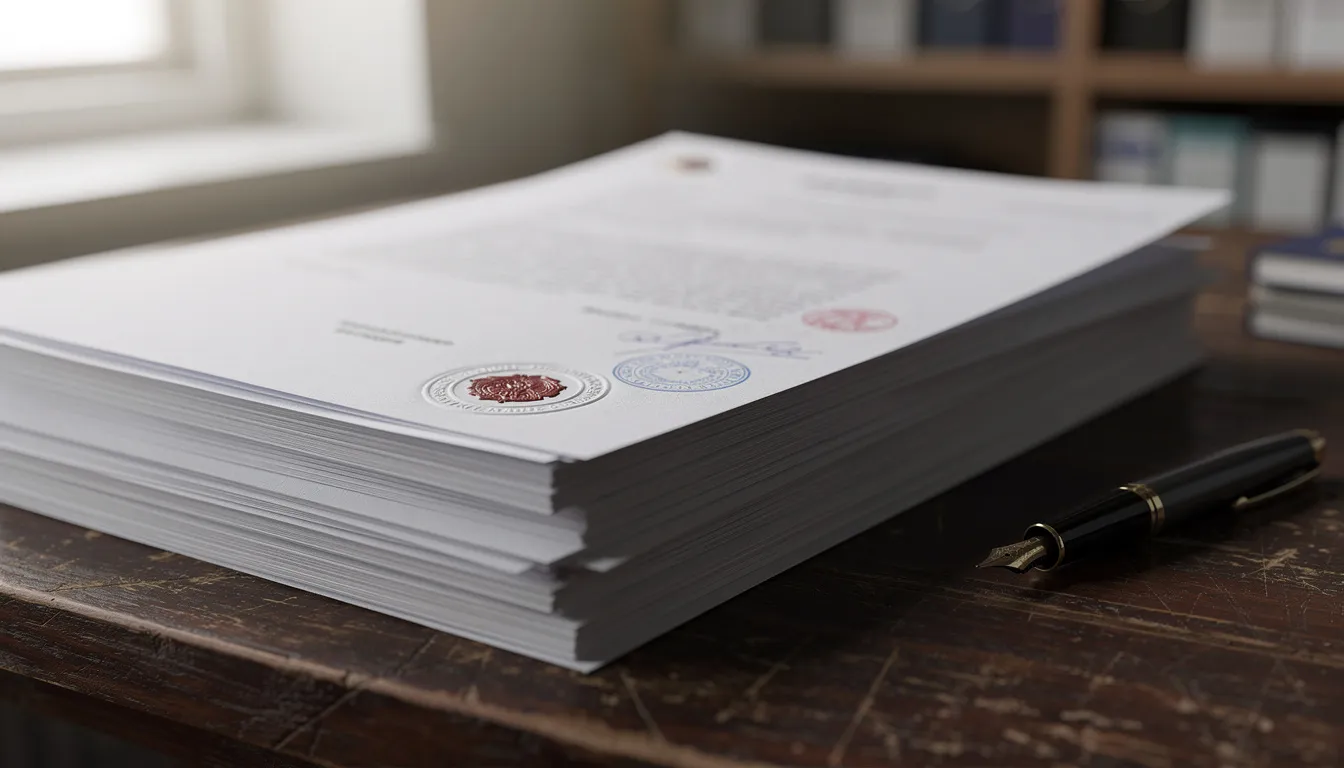
Which Vermont Documents Can Be Apostilled?
Only documents issued in Vermont, or properly notarized in Vermont, can receive a Vermont apostille. The state’s office will reject any document that originates from other states or lacks proper Vermont authentication.
Vital Records
Vermont vital records are among the most commonly apostilled documents. These include:
Document Type | Issuing Authority | Requirements |
|---|---|---|
Birth certificates | Vermont Department of Health or town clerk | Must be certified with raised seal |
Death certificates | Vermont Department of Health or town clerk | Official certified copy required |
Marriage certificates | Town clerk where marriage was registered | Must include registrar signature |
Divorce certificates | Vermont courts | Clerk certification required |
Court and State Documents
Documents issued by Vermont courts and state agencies are eligible for apostille when they bear the proper official signatures:
- Adoption decrees
- Name change orders
- Guardianship orders
- Court judgments and orders
- State agency certifications
- Good standing certification for corporations
Educational Records
Academic documents from Vermont institutions can be apostilled after proper preparation:
- High school diplomas
- College and university degrees
- Official transcripts
- School registrar certifications
Most educational documents need to be signed by a school official or notarized by a Vermont notary before submission.
Private and Corporate Documents
Private documents become eligible for Vermont apostille when properly notarized by a Vermont notary public:
- Power of attorney documents
- Consent letters for minor travel abroad
- Employment verification letters
- Corporate bylaws and resolutions
- Articles of incorporation
- Commercial invoices and authorizations
Identification Document Copies
A passport copy or driver’s license copy can only be apostilled if a Vermont notary properly certifies it as a true copy. The Vermont Secretary of State must accept that notarial act for the document to receive an apostille.
Important Limitation
Federal documents (such as FBI background checks) do not receive a Vermont apostille. These must be apostilled by the U.S. Department of State in Washington, DC, as they fall under federal government jurisdiction rather than state level authority.
How to Obtain Certified Vermont Vital Records Before Apostille
The Vermont Secretary of State requires certified copies of vital records—not plain photocopies or unofficial printouts. Submitting an original document or uncertified copy will result in your request being rejected.
Where to Order Certified Records
You have several options for obtaining certified Vermont vital records:
- Vermont Department of Health’s Vital Records Office (Vermont State Archives and Records Administration) – handles birth, death, marriage, and divorce certificates
- Town or city clerk – where the vital event was originally recorded
- VitalChek online service – government-approved vendor for faster processing
When ordering through VitalChek or directly from the department, expect to pay approximately $15 for the first certified copy and $6 for each additional copy.
What to Request
When placing your order, explicitly request “certified copies with raised seal” or similar official certification wording. This ensures the certificate meets the requirements for apostille documents issued by Vermont authorities.
You’ll typically need to provide:
- Full legal name on the record
- Date of the event (birth, death, marriage)
- Place of event (city or town in VT)
- Parents’ names (for birth certificates)
- Your relationship to the person on the record
- Valid identification
Avoid Common Mistakes
Photocopies, shortened abstracts, or commemorative hospital certificates are generally not accepted for apostille purposes. Always request long-form certified copies where applicable, as these contain the official seal and registrar signatures needed for authentication.
Vermont Apostille Requirements and Special Guidelines
The Vermont Secretary of State will reject documents that are not properly notarized, not certified, or not clearly originating from Vermont. Understanding these requirements before submission saves significant time and frustration.
Notary Requirements
For documents requiring notarization, the notarial certificate must include:
- Full notarial certificate language
- Notary signature (signed in ink)
- Notary’s printed name
- Commission expiration date
- Notary seal (if used by that notary)
- Confirmation the notary is a currently commissioned Vermont notary public
Recordable vs. Non-Recordable Documents
Document Type | Certification Needed |
|---|---|
Vital records | Official certification from issuing Vermont office |
Court documents | Judge or clerk signature with seal |
Private documents | Notarization by Vermont notary public |
Corporate documents | State or notary certification |
Recordable documents like vital records or court orders must carry the official certification from the issuing Vermont office—not simply a notarized copy made afterward.
Translation Requirements
Foreign-language documents may need translation into English by a qualified translator. The translator’s certification must then be notarized by a Vermont notary before the entire package can receive an apostille.
Name Matching
The names on your documents should match your current legal name. If there’s a discrepancy due to marriage or legal name change, include supporting evidence (such as a marriage certificate) to prevent problems with foreign authorities, even though Vermont will still issue the apostille.
Keep Documents Intact
Once the Secretary of State or a notary has attached pages together, do not remove staples or attachments. Breaking the staple on translations or multi-page documents can invalidate the certification, requiring you to restart the process.

Step-by-Step: How to Get an Apostille from the Vermont Secretary of State
This section provides a practical, chronological guide that walks you through the process from document preparation to receiving your apostilled documents by mail.
Step 1: Review Your Documents
Confirm that each document is either:
- A certified copy issued in Vermont (for vital records, court documents)
- A document properly notarized by a Vermont notary public
Check for official seals, signatures, and proper certification language before proceeding.
Step 2: Download and Complete the Request Form
Visit the Vermont Secretary of State’s official website to download the VSARA-35 Apostille/Certificate of Authentication Request Form. Fill it out completely with:
- Your name (requester)
- Complete mailing address
- Contact information (phone, email)
- Destination country where the document will be used
- Document type being submitted
Step 3: Choose Apostille or Authentication
On the form, select “apostille” if the destination country is a Hague Convention member. Select “authentication” if it is not.
Hague Members (Apostille) | Non-Hague Countries (Authentication) |
|---|---|
Germany, France, Italy | Canada (for some documents) |
Spain, Mexico, Netherlands | China, UAE, Saudi Arabia |
Australia, Japan, South Korea | Many Middle Eastern nations |
Step 4: Prepare Payment
Enclose payment by check or money order payable to “Vermont Secretary of State.” The current cost is $10 per document—one of the lowest fees in the country compared to other states like New York or California. For businesses needing international document processing, consider reviewing apostille translation services to ensure accurate and efficient legalization.
Do not send cash. Checks must be drawn on a U.S. bank.
Step 5: Mail Your Package
Send the following to the Secretary of State’s mailing address in Montpelier, Vermont (128 State Street):
- Original document(s) requiring apostille
- Completed request form
- Payment (check or money order)
- Prepaid return envelope (optional but recommended)
Use a trackable mail service such as USPS Priority Mail, FedEx, or UPS to monitor delivery.
Step 6: Wait for Processing
Standard processing time is typically 5-7 business days from the date the state receives your documents, plus mailing time back to you. Including a prepaid FedEx or UPS label can speed up return shipping significantly.
Pro tip: Incomplete forms, incorrect payment amounts, or improper notarizations will cause rejection or delay. Double-check everything before sealing your envelope.
Using a Professional Vermont Apostille Service
Many individuals and businesses choose to work with professional apostille services to avoid mistakes and speed up turnaround times. This approach is particularly valuable when deadlines are tight or the client is located outside Vermont or the United States.
How Professional Services Work
The typical workflow looks like this:
- Client ships documents to the apostille service (or uploads scans for review)
- Service checks whether notarization and certifications meet Vermont standards
- Service arranges any needed corrections or additional notarization
- Service submits documents to the Vermont Secretary of State
- Apostilled documents are returned to the client via express shipping
Benefits of Using a Service
Benefit | Description |
|---|---|
Error prevention | Experts review documents before submission |
Expedited handling | Established workflows with state offices |
Tracking | Real-time updates on document status |
Consolidated processing | Multiple documents for different countries handled together |
Additional services | Can coordinate FBI apostilles, county clerk steps, translations |
Cost Considerations
While professional services charge fees above the state’s $10 filing cost—often starting around $75 per document including expedited return shipping—the investment makes sense when:
- You’re facing a tight deadline for travel or business abroad
- You’re located outside Vermont and can’t easily correct rejected submissions
- You need multiple documents processed efficiently
- You’re unfamiliar with authentication requirements
The cost versus time trade-off is particularly favorable for businesses needing bulk processing or individuals dealing with complicated document packages.

FAQ
This section answers common follow-up questions about Vermont apostilles that aren’t fully addressed above.
How long does it take to get a Vermont apostille?
Processing time at the Vermont Secretary of State’s office typically requires 5-7 business days from receipt of documents, plus mailing time in both directions. If you’re mailing from overseas or a distant state, expect the total turnaround to extend to 2-3 weeks.
Using trackable express courier services both ways can reduce delays significantly. Professional apostille companies sometimes offer expedited handling through their established workflows, which can shorten practical turnaround time to as little as 3-5 business days total.
Can I walk in to the Vermont Secretary of State’s office for an apostille?
Vermont generally processes apostille requests by mail, and there may not be full-service walk-in counter options for same-day service. While the Montpelier office (128 State Street) may accept drop-offs during business hours, documents might not be completed the same day depending on staffing and volume.
Before attempting in-person submission, check the most recent instructions on the Vermont Secretary of State’s official website or contact the office directly to confirm current procedures and hours.
Do I need an apostille or authentication if the country is not in the Hague Convention?
If your destination country is not a Hague Convention member, the document needs authentication rather than an apostille from Vermont. After state-level authentication, you’ll also need U.S. Department of State certification, followed by legalization at the foreign country’s embassy or consulate in the United States.
Due to these multiple steps, many people use a professional legalization service for non-Hague destinations to avoid errors and repeated visits to government offices. This process is considerably more complicated than obtaining a standard apostille.
Can Vermont apostille a document that was issued in another state?
The Vermont Secretary of State can only apostille documents whose notary or issuing authority falls under Vermont jurisdiction. Birth certificates, court orders, or other documents issued in other states must be apostilled by that state’s Secretary of State or equivalent office.
For federal documents like an FBI background check or U.S. Consular report, the apostille must come from the U.S. Department of State in Washington, DC—not from any state-level authority.
Does a Vermont apostille expire?
The apostille itself does not have an expiration date printed on it. However, foreign authorities often require that underlying documents—especially vital records and background checks—be relatively recent, typically issued within the last 3-12 months.
Before traveling or submitting documents abroad, confirm with the foreign institution, consulate, or immigration authority how recent your Vermont document and apostille must be for acceptance. If an older document is rejected, you’ll need to request a new certified copy from Vermont and obtain a fresh apostille.
